Sites Around the Maaria Basin
Do you want to see a bridge that leads nowhere? Feel like climbing rocks or wandering through a dark spruce forest? Are you interested in Stone Age dwelling sites or ancient springs? Would you like to spot a flying squirrel? These are just a few reasons why the surroundings of the Maaria Basin are worth exploring. The area offers an extensive and diverse network of trails, providing plenty to discover over multiple days. At the same time, the distances are not long, making it easy to visit for a short trip by bus or bicycle.
The Maaria Basin is located about ten kilometers northeast of Turku’s city center. Originally dammed as a backup water source for Turku, the basin and its surroundings are well worth exploring. The approximately five-kilometer-long artificial lake can be explored from the water by inflatable boat or SUP board. However, there is no designated boat launch, so bringing a large boat is not recommended. Water activities are allowed only with non-motorized vessels. The shore is easily accessible from the western end of the basin at the Maaria Basin dam in Åvik beach, or from the middle of the basin near Äkölä.
Kukonmäki
The old Paimala school is located in Kukonmäki. There is a parking area on the school field, near which you can find the Myllyoja Bridge, Äkölä’s Krotti, and the Kukonmäki ancient spring. The ancient spring is located along a trail that leads north into the forest from the parking area.
Maaria Stone Age Trail
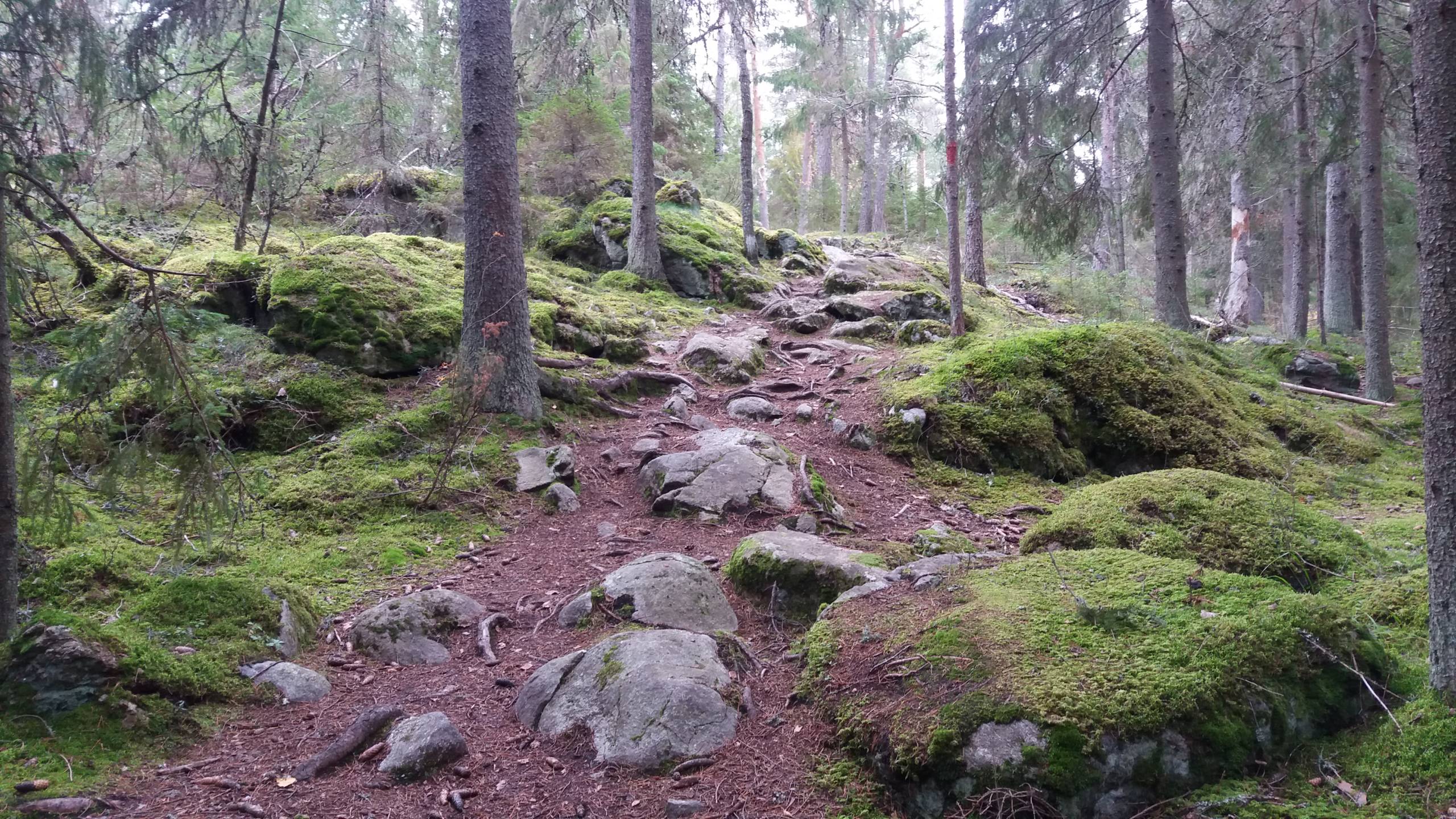
The approximately six-kilometer Maaria Stone Age Trail runs through diverse terrain on the eastern side of the basin. The trail is named after the Stone Age dwelling sites discovered in the area. It leads hikers across rocky hilltops and into dense spruce forests. Sections near the river are mainly spruce-dominated woodlands, while the terrain on the rocky outcrops is more rugged.
Interesting landmarks along the route include Rajakallio, located on the border of Lieto and Turku, and the Giant’s Rock. Rajakallio is a great place to stop for a break, with a table available for resting and enjoying a snack. The trail begins at the Karhunojantie parking area, but it can also be accessed from Myllyoja Bridge. The Stone Age Trail is marked with red paint, and part of it overlaps with the blue-marked Paavo Trail, which loops closer to the Jäkärlä residential area.
Äkölä’s Krotti
Äkölä is located in the central part of the present-day Maaria Basin. The word krotti refers to a steep-sided pit or ravine. Äkölä’s Krotti contains an ancient spring that was submerged when the area was dammed. Cup stones have also been discovered at the site.
The Myllyoja stream flows into Krotinlahti Bay, which has a suitable shoreline for launching a boat or starting a paddling trip. The Krotti area is just a short walk from the old Paimala school field and nearby bus stops.
Maaria Basin Dam
Completed in the early 1980s, the dam caused the water level to rise in the upstream section of the river, forming the Maaria Basin. The basin was originally created as a raw-water reservoir for Turku. Today, Turku’s drinking water comes from artificial groundwater in Virttaankangas, and water from the Maaria Basin is no longer used for this purpose.
The dam is easily accessible by car or bus. Although the dam area itself is fenced off, visitors can reach the nearby shoreline to observe birds or enjoy the scenery.
Myllyoja Bridge
From Paimalantie, Myllyoja Bridge appears to lead nowhere, as only footpaths and cycling paths extend from both ends. Despite this, the bridge is remarkably sturdy for a pedestrian structure. Completed in 1980, the steel-framed bridge replaced the older Äkölä Bridge, which previously crossed the Vähäjoki River at Äkölä Spring. Today, Myllyoja Bridge is an important link for outdoor recreation, connecting the eastern and western sides of the Maaria Basin.

Myllyoja Bridge
The Stone Age Trail

Maaria Basin Dam
Cover photo: Suvi Hakulinen, Aura River Foundation
Other photos: Ville Autio, Aura River Foundation